
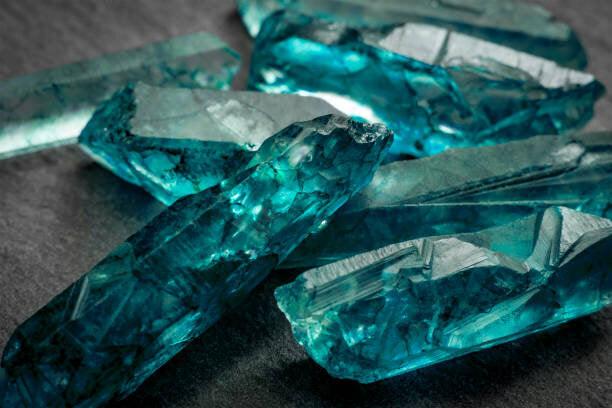
Topaz (gem)
Species: TOPAZ
Variety: According to colours
Colour: All colours
Transparency: Transparent
Crystal system: Orthorhombic
Chemical formula: A12SiO4(F,OH)2
Chemical composition: Aluminium fluorosilicate
Refraction: Positive biaxial birefringence
Refractive index: 1.618-1.621-1.628
Birefringence: 0.010 (-0.002)
Dispersion: 0.014
Pleochroism: Pink and red tones: from weak to strong, light red and yellow; brown, yellow and orange tones: from weak to strong, yellow-brown, yellow and yellow-orange; violet tones: from weak to strong, blue-violet and purple red; green tones: weak, blue-green and light green
Fluorescence: Colourless, blue and green tones: generally none, sometimes slight yellow or green (OL) and very slight (OC); other colours: generally slight yellow-orange (OL) and very slight (OC)
Density: 3.53
Hardness: 8
Habitus: Pseudotetragonal prismatic
Deposit genesis: Pneumatolytic magmatic
Main deposits: Algeria, Australia, Brazil (Minas Gerais, Minas Novas), Japan, England, Mexico, Myanmar, Namibia, Nigeria (Jos), Pakistan (Gilgit), Russia (Siberia, Urals), Scotland, Sri Lanka (Matale), United States (California, Colorado, New Hampshire, Texas, Utah), Zimbabwe (Miami)
Technical specifications
The name topaz probably derives from the island of Topazos in the Red Sea: according to some, the etymology instead refers to the Sanskrit term tapas (fire). Topaz crystals are mainly found in veins of pneumatolytic magmatic origin in silica-rich rocks. Due to its high hardness, it is possible to obtain a well-preserved mineral even in secondary deposits of alluvial formation. Topaz crystallises in the orthorhombic system and belongs to the nesosilicates, meaning its structure is based on isolated SiO tetrahedra linked by aluminium in octahedral coordination, to which F and OH ions are also bound. This very compact structure causes the high density and hardness: indeed, topaz was chosen by Mohs as the eighth term of his scale. The habitus is pseudotetragonal prismatic with crystals elongated along the c axis ending at the extremities with a combination of pyramids and a basal pinacoid. Cleavage is perfect along the basal plane. The fracture is conchoidal and the lustre vitreous. Topaz should not be subjected to high temperatures as fractures and colour changes may occur. Some brown stones may fade with prolonged exposure to sunlight. Polishing should not be done with ultrasounds or steam but only with lukewarm water and soap.
The numerous colours in which this mineral is found determine its varieties, which must be indicated by following the term "topaz" with the colour of the sample in question (e.g. yellow topaz, blue topaz, colourless topaz, etc.). Any other terminology should be abandoned. The yellow-orange variety is the best known and appreciated in jewellery: it was wrongly known as "imperial topaz" and is still imitated by citrine quartz. In the past, the blue variety, with shades ranging from deep blue to blue-green, was considered equally precious: in the last decade, significant quantities of treated material, indistinguishable from natural, have been introduced to the market, causing a steep price drop. Topaz can take on pink tones while red colouring is very rare. Colourless topaz was used as a diamond imitation even though the only characteristics shared by the two minerals are colour and density. Other varieties are rarely used in jewellery.
The nature of the colours is attributed to colour centres of unknown origin for the blue, brown and yellow varieties, and to Cr3+ ions in octahedral coordination for the pink and red colours, while other colours are presumed to be formed by the combination of the causes already mentioned (e.g. violet = red + blue, green = blue + yellow, orange = red + yellow). Topaz varieties can be divided into two groups characterised by slightly different refractive index and density values.
Generally, there are colourless, green and blue varieties with n = 1.608-1.611-1.618 and density from 3.53 to 3.57; yellow, brown, orange, pink, red and violet varieties usually have n = 1.628-1.631-1.638 and density from 3.49 to 3.53. It is not always possible to verify the biaxial character of this gem with a refractometer as the intermediate index 𝞫 is close to the lower index 𝞪. The shift of the lower index therefore appears very limited and is not always detectable; in this case, the sample may appear uniaxial positive. Fortunately, there are no uniaxial positive gems with indices close to those of topaz and, in any case, this can be distinguished from tourmaline, brazilianite, apatite, andalusite and damburite by the higher density values. Very rarely, topaz may show zoning in blue and yellow-orange colours.
Internal characteristics
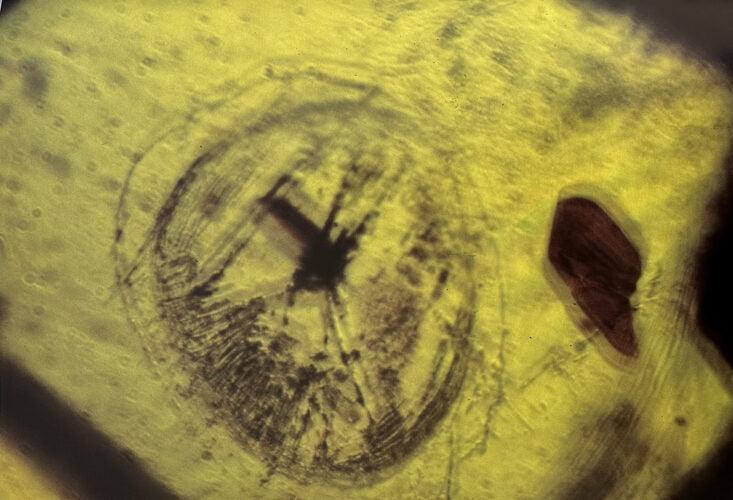
Samples used in jewellery generally do not show many inclusions and in some cases may be free of them. Liquid inclusions in topaz tend to take the form of negative crystals arranged on planes parallel to the c axis and prism faces. Fluid inclusions often appear as two-phase levels but are actually formed by two immiscible liquids such as aqueous saline solutions and liquid carbon dioxide. Rarely, a solid phase may also be present, usually consisting of rock salt, quartz, sylvite or cryolite. Among solid inclusions are found: prismatic apatite crystals; acicular or prismatic plagioclase crystals; tufts of goethite, yellow or red if altered; colourless muscovite mica sheets; fluorite and monazite crystals; tourmaline or hornblende needles; hematite sheets which may alter to limonite.
Treatments
By irradiating pink, red, violet or colourless topazes, brown-orange varieties can be obtained. Heating can produce the opposite effect, changing brown samples to colourless or pink if chromium ions are present. Recognition of these treatments is difficult and not always possible. The pink colour obtained by heating shows much stronger pleochroism (light pink - yellow) compared to the natural one, which is rare. Brown topazes obtained by irradiating colourless ones have refractive indices typical of colourless material, lower than the natural brown variety. Some brown topazes may fade with exposure to sunlight while others have stable colouring. This occurs due to the presence of different colour centres, stable and unstable, whose nature is still unknown. Irradiation of colourless topazes also produces brown-green varieties whose yellow component is due to unstable colour centres that are subsequently deactivated by moderate heating or simply by exposure to sunlight. Once the yellow component is removed, blue, light blue or blue-green topazes are obtained, stable to sunlight, identical to those found in nature. Heating to about 450°C causes blue topazes, both natural and treated, to fade and become colourless again. Recognition of this treatment is practically impossible.
Although particularly intense blue shades, not normally found in nature, reveal the artificial origin of the colour, there are no commonly used, non-destructive instrumental tests capable of proving this fact. It should also be considered that naturally blue gems may have undergone a similar natural irradiation process in the millennia following their formation. The radiation used to "bombard" topazes is usually gamma rays generated by the radioactive isotope cobalt 60; these radiations produce uniform colouring, require no electrical energy consumption and minimise the possibility of inducing radioactivity in the treated sample. X-rays do not have enough energy to activate colour centres, while neutrons and electrons can induce residual radioactivity in gems. Colourless topazes used for treatment are generally poor in atomic-level impurities; this is an advantage as some impurities could "activate" during the process, generating radioactivity for long periods.

2%0A%20%0AChemical%20composition:%20Aluminium...)