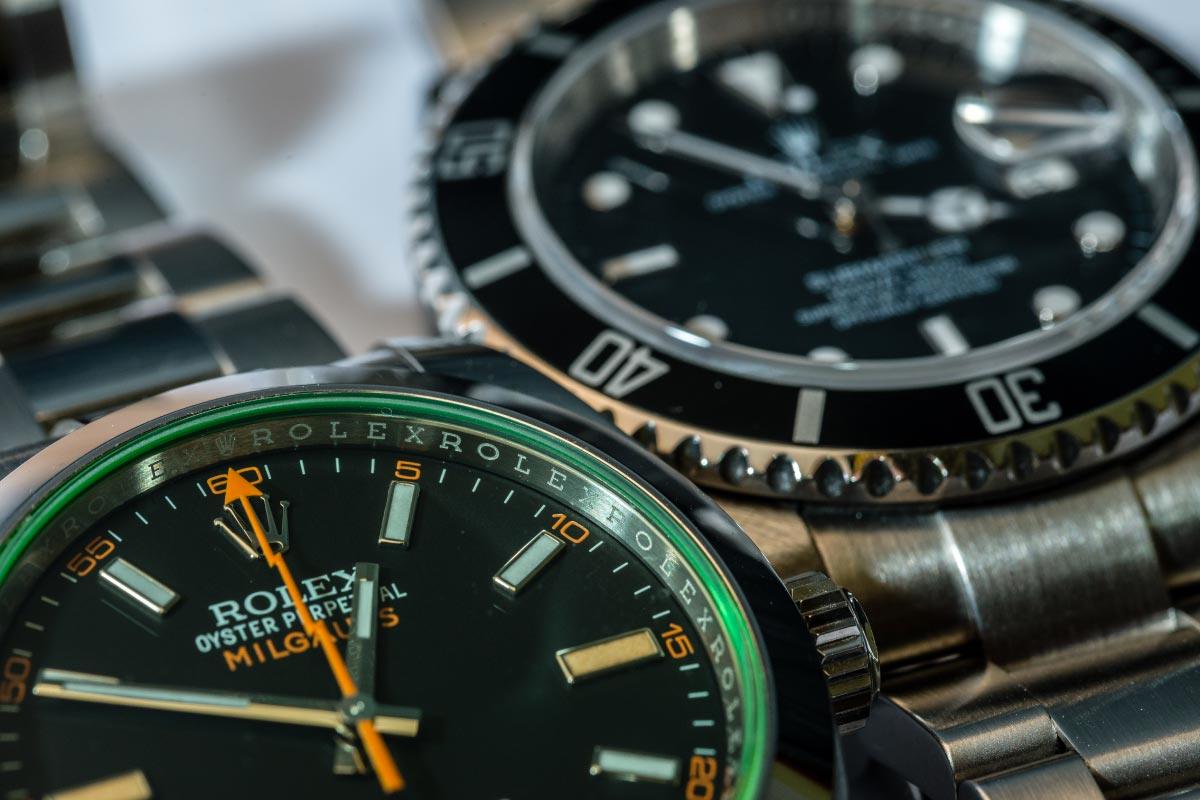
Have you ever wondered how a watch works? We have already seen together what mechanism characterizes quartz watches... today, therefore, we move on to discovering the automatic watch! Let’s find out together
what "automatic watch" means!
The history
The first chronographs with automatic movement were invented by
Abraham-Louis Perrelet and Abraham-Louis Breguet, but their first true industrial realization dates back to 1931, with the Perpetual system of the famous firm
Rolex, still among the most important in the world. Currently, there are various calibres for the automatic mechanism on the market, from the more common to those extremely sought after and complicated. Some of the most important brands in the production of automatic watches are Miyota, ETA, and Seiko.
The mechanism
The fundamental feature of an automatic watch is its ability to recharge itself by exploiting the movement of a rotor placed inside the watch itself.
The winding is automatic and is given by the movement of the wrist that wears the chronograph itself! Definitely more practical compared to the old manual winding watches!
In detail
The operation of the automatic mechanical movement is due to the
kinetic energy released by the movement of the arm. The rotor spins around a pivot and, moving with the oscillation caused by the moving wrist, acts on a small spring that rewinds the entire mechanism. The mechanism of an automatic watch is called
calibre. The functionality and precision of the watch itself depend on the calibre.
Energy that transforms
But how is the energy of movement transformed into energy functional to winding the watch? All this is due to the
rotor, which we mentioned earlier. This component of the automatic mechanism is a small weight that swings in a special housing with each movement. It then transmits its energy through a series of gears, reaching the
winding spring, located in the so-called
barrel. Complicated? Quite!
Types of mechanism
It is important to know that there are two different winding systems:
unidirectional and bidirectional. In the first type, the motor winds the spring only if it rotates in a certain direction. In bidirectional ones, instead, winding can occur in both directions, thanks to some reversing gears.
How the hands advance
To allow the hands to advance, thus indicating the passage of time, there is a special small pendulum called
balance wheel. It determines regular intervals at which the escapement releases the
gear train: in simple terms, it is the balance wheel that allows the hands to move regularly, through the energy present in the mainspring.
The drawbacks
As for the drawbacks of this type of watch, it is good to know that, compared to manual counterparts, automatic chronographs are more expensive and more difficult to maintain. Their mechanism, so complicated and rich in components, makes them truly
delicate.
Our advice
Among the most prominent automatic movement watches on the market, we cannot fail to mention, besides the brands named earlier, the famous TagHeuer. Beautiful and functional, suitable for everyone thanks to the wide variety of styles they possess. These are high watchmaking products, definitely of quality: not to be missed if we want an automatic chronograph worthy of its name on our wrist! You can discover them better in store or on our official website and online shop,
Ferro Gioielli. I hope today’s article has been interesting and useful to learn something more about the world of watches. See you here again very soon, with a new article!