
Peridot (gem)
Species: PERIDOT
Color: Green, yellow-green, green-brown
Transparent: Transparent
Crystal system: Rhombic
Chemical formula: (Mg,Fe)2(SiO4)
Chemical composition: Iron and magnesium silicate
Refraction: Positive or negative biaxial birefringent
Refractive index: 1.654-1.672-1.690 (+0.017/-0.004)
Birefringence: 0.036 (±0.002)
Dispersion: 0.020
Pleochroism: Very weak, yellow-green and green
Density: 3.34 (+0.15/-0.07)
Hardness: 6 ½ - 7
Form: Prismatic
Origin of deposits: Magmatic
Main deposits: Australia (Queensland), Brazil (Minas Gerais), China (Hebei), Egypt (Zebirged), Kenya, Myanmar (Mogok), Mexico, Norway (Sondmore), Sri Lanka (Ratnapura), United States (Arizona, Hawaii), South Africa.
Technical specifications
The origin of the term peridot is uncertain; it is supposed to derive from the Greek language meaning "abundance," referring to the numerous faces present in its crystals. Peridot is an isomorphic mixture of forsterite (Mg2SiO4) and fayalite (Fe2SiO4) which, in varying proportions, produce a series of crystals known in mineralogy as olivines. These minerals take different names depending on the Mg/Fe ratio; starting from magnesium-rich terms to those rich in iron, six terms are distinguished: forsterite, chrysolite, hyalosiderite, hortonolite, ferrohortonolite, fayalite. Peridot represents the transparent variety used as a gem and usually belongs to the chrysolite term being richer in magnesium than iron. In the past, the word chrysolite referred to peridot with a more yellowish coloration. Olivines belong to the nesosilicates and as such are composed of isolated SiO4 tetrahedra, linked together by iron and magnesium atoms in octahedral coordination with oxygen. Peridot is found in igneous rocks formed during the early stages of magmatism and is a main component of some rock formations such as peridotites. The presence of this mineral has also been found in meteorites and lunar rocks. The entire olivine group easily alters into minerals such as serpentine and chlorite. The habit of the crystals is prismatic although they are more frequently found in rounded nodules. Cleavage according to the pinacoid is rarely observed, the fracture is conchoidal and the luster vitreous. Peridot crystals fracture fairly easily both under pressure and rapid heating; for these reasons it is advisable to clean it only with lukewarm soapy water and never with ultrasounds or steam. Peridot is attacked by hydrochloric and sulfuric acids but is stable under prolonged exposure to sunlight. The coloration derives from the presence of iron and for this reason the mineral could be defined as idiocromatic, but it seems that the hue is influenced by chromium impurities, often present, in octahedral coordination, together with nickel.
Usually this gem is not subjected to treatments although, with heating, it is possible to lighten some samples particularly rich in iron. Since the last century, attempts were made to synthesize the mineral but, given its modest commercial value, it was not deemed worthwhile to develop this project. Due to its coloration and refractive index values, peridot can be confused with other biaxial birefringent gems such as: hiddenite, cornerupine, diopside, and sinhalite. Peridot is distinguished by having the lowest 𝜶 refractive index, high birefringence, absorption spectrum, and, when present, characteristic inclusions. It is not always possible to determine the optical sign of this gem since its B index is close to the midpoint of the 𝜶-𝜸 range. It should be noted that small variations in the intermediate index can produce samples that are optically positive or negative.
Internal characteristics
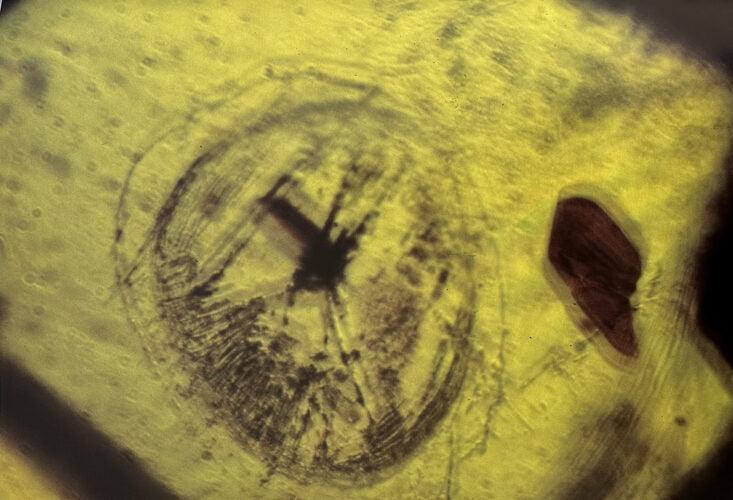
Being a mineral not very rare, peridot can produce gems poor in or free of inclusions. The most typical of these are those called, in English, Lily pads, surrounded by disc-like cleavages. These circular halos form due to stresses generated by the different thermal expansion of the included crystal and can later be filled by healing liquid inclusions that appear as circular fins with a fine and orderly mesh. When the liquid inclusions heal other types of fractures, they can produce fins of different shapes. Often peridots show misty trails, similar to smoke, of silvery white color when illuminated in dark field, due to stresses caused by zones of incomplete solid solutions. Among solid inclusions, the most frequent are: spinel, in octahedral crystals, brown-reddish; chromite, black; biotite, in brown flakes; and diopside in green crystals.
The volcanic origin of some peridots is evidenced by the presence of solidified amorphous zones called glassy drops. In some meteorite-origin peridots, crossed needle-like inclusions perpendicular to each other have been observed, probably produced by exsolution phenomena due to changes in temperature and pressure.

2(SiO4)%0A%0A%0A%0AChemical%20composition:%20Iron%20and%20magnesium%20s...)