
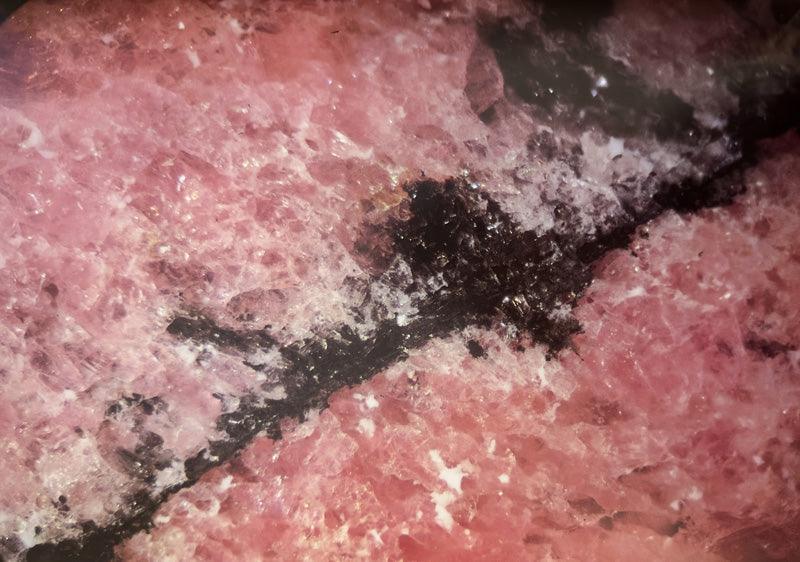
Rhodonite (gem)
Species: RHODONITE
Variety: Bustamite
Color: Pink, generally with black speckles
Transparency: From opaque to transparent (rare)
Crystal system: Triclinic
Chemical formula: MnSiO3
Chemical composition: Manganese silicate
Group: Amphiboles
Refraction: Positive biaxial birefringent
Refractive index: 1.733-1.736-1.746 (+0.005/-0.021)
Birefringence: 0.013 (+0.001/-0.003)
Pleochroism: Medium-weak: red-orange and red-brown
Density: 3.53 (±0.23)
Hardness: 5 ½ - 6 ½
Habit: Prismatic
Deposit genesis: Metamorphic
Main deposits: Australia, Brazil, Germany, Italy (Calabria, Liguria, Val d'Agno, Aosta Valley, Val Malenco), Mexico, Romania, Russia, United States (New Jersey, Montana), Sweden, South Africa.
Technical specifications
Rhodonite belongs to the alkali amphiboles and owes its origin to metamorphic processes affecting manganese deposits. The mineral's name derives from the Greek ròdon, meaning rose, understood as the flower.
The crystal structure is based on chains of five SiO4 tetrahedra linked by an equal number of manganese ions; for this reason, in mineralogy, the chemical formula is preferably indicated as Mn5(Si5O15). Manganese is largely replaced by iron, magnesium, and calcium ions. As with most amphiboles, the habit is elongated prismatic, but microcrystals often gather in opaque aggregates. Rhodonite is idiocromatic because its pink color derives from manganese ions. The opaque variety shows black speckles due to manganese oxide; other impurities can cause the formation of greenish or yellowish zones. This mineral, when opaque or translucent, is cut with a curved surface; some rare transparent gems are faceted and mainly purchased by collectors. A fibrous-radiated variety, gray-pink in color, called bustamite, differs due to a higher percentage of calcium replacing manganese; it may sometimes show chatoyancy. Rhodonite's fracture can be conchoidal or irregular, its luster is vitreous, and cleavage is perfect in two nearly perpendicular directions (92°30'), although it is not observed in compact aggregates. This mineral is fairly resistant to alteration: it is weakly attacked by acids, normally not damaged by ultrasounds or steam, and stable under prolonged exposure to sunlight; however, its low melting point means it easily melts under the action of a jeweler's torch. Gemological examination is based exclusively on observing the external appearance and recording characteristic physical-optical data.

%0A%0A%0A%0ACrystal%20system:%20Triclinic%0A%0A%0A%0AChemical%20formula:%20MnSiO3%0A%0A...)