Sapphire: features and curiosities
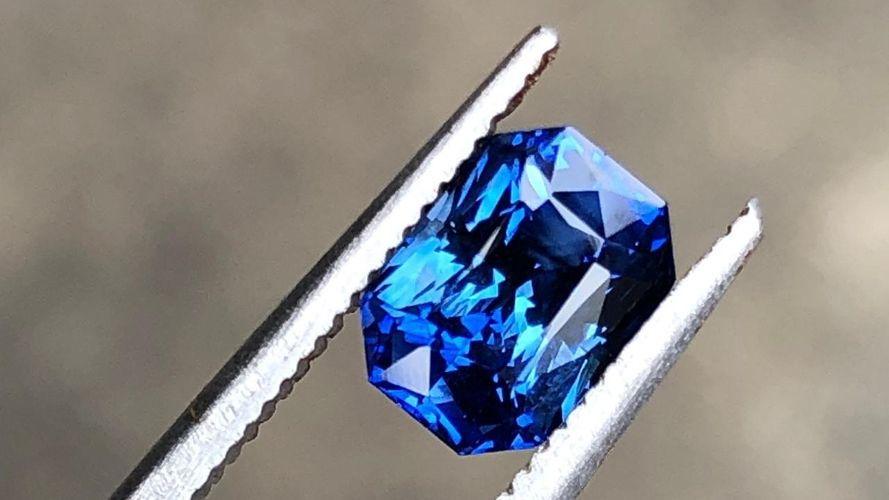
Among the precious stones most famous worldwide, Sapphire cannot be missing, with its blue and sky-blue shades, loved since ancient times and believed to have miraculous powers. We have already met the diamond, the ruby, and the emerald. Today, let us discover together the Sapphire: features and curiosities of one of the foremost gems!
The name and the history
The sapphire, pronounced with the stress either on the à or on the ì according to preference, is one of the most beloved and well-known precious stones worldwide. Its name would derive from Greek σάπφειρος (sàppheiros), "blue," referring to the gem’s deep and captivating color. Other sources trace its name back to Hebrew ספיר (sappir), "the most beautiful thing."
In both cases, Sapphire is understood as a gem of very high value, precious and truly beautiful to behold.
In a different sense, the term "sapphire" seems instead to come from Sanskrit sanipriya, "devoted to Saturn." Indeed, this planet regards sapphire as a precious stone linked to it by myths and legends of old.
Since ancient times, Sapphire has been considered a precious stone rich in ancient powers, connected to the Earth and at the same time to the Sky, consecrated to Apollo and Saturn, and bearer of positive prophecies.

What it is made of
Sapphire is a variety of corundum, chemically understood as aluminum oxide strongly colored, of great hardness. For those less expert, it is a corundum with blue-sky shades, whose formation occurs in magmatic rocks containing aluminum. Its deep color comes from the presence of hematite within it, and its hardness makes it one of the hardest stones in the world.
There are also sapphires of other colors, depending on the type of infiltrations present inside the gem. In any case, sapphire is usually blue.
At the beginning of the 1900s, the French chemist Auguste Verneuil created the first synthetic sapphire in the laboratory. To distinguish it from natural versions, analyses of internal inclusions and the stone’s spectrum are required. Although these are lab-created sapphires, they are very similar to their natural counterparts, scratch-resistant, and often used in watchmaking.
Where it is found
The countries with the greatest number of sapphire deposits are Australia, Sri Lanka (especially the island of Ceylon), Myanmar, Thailand, Cambodia, Vietnam, Madagascar, and India.
Small sapphire crystals can also be found in Italy, in the Calcite of Monte Terminillo, in the province of Rieti. The gems collected in Italy are mostly sold with oval or round cuts. The United States also boasts a number of sapphire deposits.

Its features
As mentioned, there are not only blue sapphires, though they are the most famous. Infiltrations and traces of chemical elements such as chromium, titanium, and iron lead to the formation of "Fancy" sapphires in green, orange, red, purple, and yellow shades. The rarest, the orange one, is the most prized in jewellery. It has been renamed padparadscha, from the Sanskrit "color of the lotus," with a hue that fades from orange to pink.
Some sapphires also contain particles shaped like a star. These are called "asteriated sapphires" and are among the most beautiful in the world.
The largest pure sapphire ever found was in India in 1827, weighing nearly 1000 carats. It is currently housed in the Mineral Museum of Paris as a unique specimen worldwide.
The economic value of Sapphire depends on its color, brightness, size, and clarity. Smaller sapphires are worth a minimum of 20 dollars each, while high-quality, untreated gems (and thus very rare) can reach 1000 dollars per carat.
Some small curiosities
Sapphire has always been a stone with strong symbolism. It is thought to grant kindness and loyalty to those who wear it. It is a symbol of purity and spirituality, used in ancient times to aid oracles. Its connection with the sky comes from the ancient Persians, who believed that the color of the heavens depended on the Earth resting on a gigantic sapphire.
Among the most famous sapphires stands the Black Star of Queensland, the largest star sapphire in the world, about 800 carats. Discovered in Australia by twelve-year-old Roy Spencer, it was mistaken for a common black crystal and used as a doorstop. It was later discovered to be a sapphire of priceless value: a star sapphire with an unusual black color, beautiful and truly unique.

Among the uses of sapphire, besides being a precious stone used in jewellery, is also its role in the world of timepieces.
Truly a precious stone of immeasurable charm, sapphire is the perfect gem for the finest jewels. Paired with yellow gold or white gold, it highlights all its brightness and that of the wearer.