
Rolex Milgauss: history and curiosities
The story of the Rolex Milgauss
It is said that at the time, scientists at CERN (European Organization for Nuclear Research) directly contacted Rolex to request a watch they could safely wear while trying to uncover the secrets of the universe in the famous high-energy particle accelerator located in Geneva.
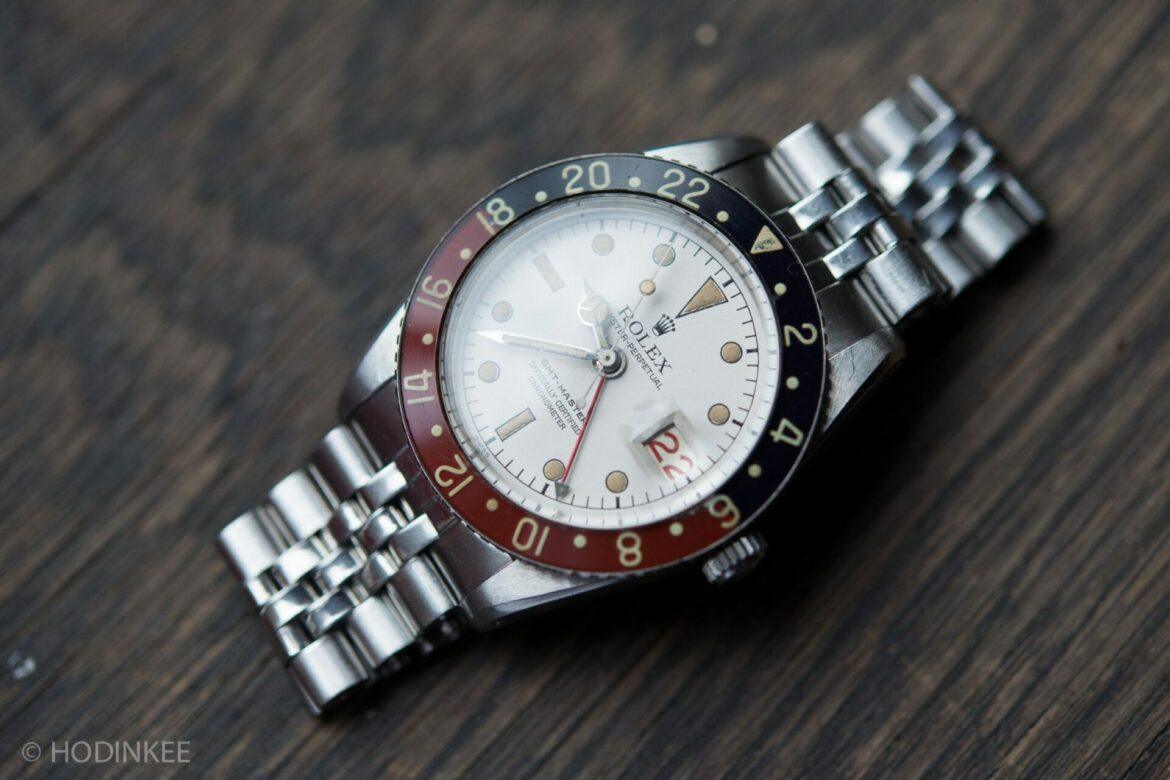
There is no definite proof of this, but this story is not so far from that of Pan-Am, which requested from the Maison a watch capable of simultaneously displaying two time zones. (GMT-Master) Read the article on the GMT-Master
Reference 6543
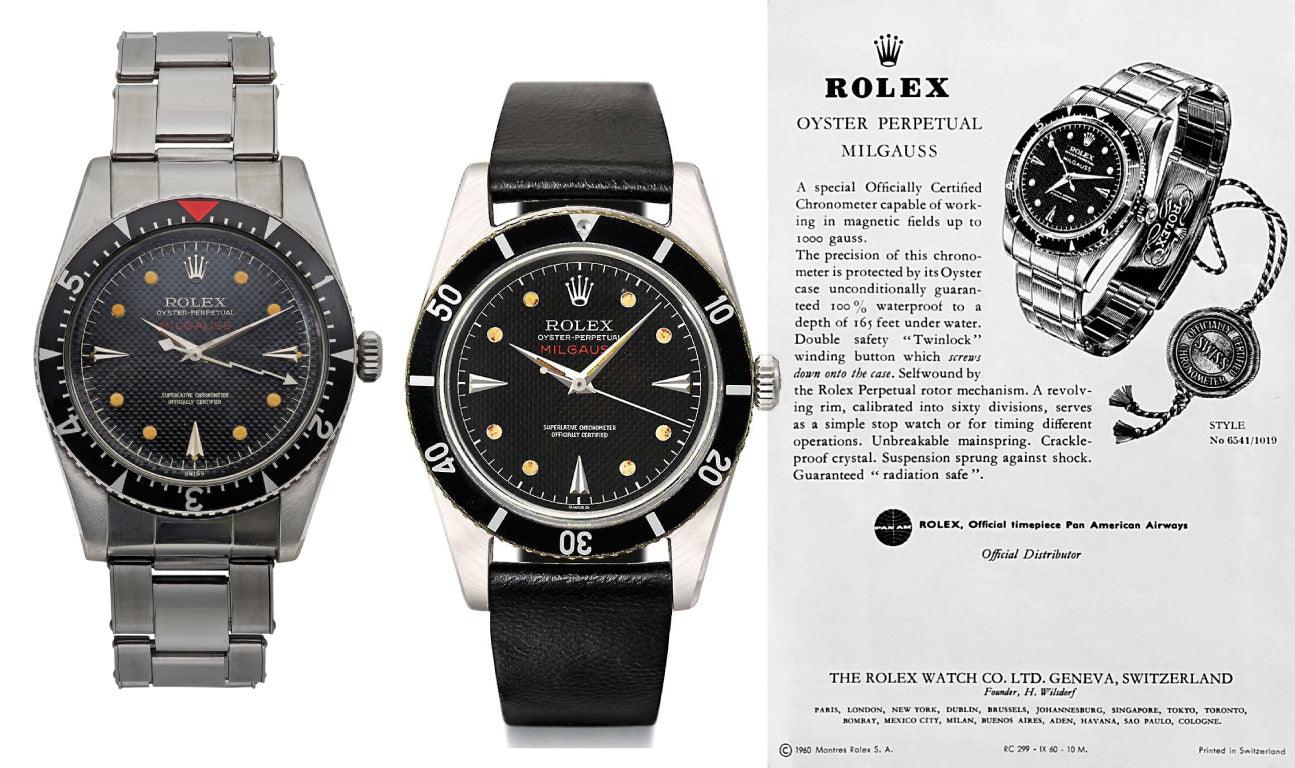
In 1956, the first Rolex Milgauss was born - reference 6543 - which takes its name from the number one thousand and the "gauss," the unit of measurement for magnetic fields.
The Milgauss, made only in steel, was created to meet the needs of scientists working in "at risk" environments, i.e., exposed to magnetic fields. Among the main features of ref. 6543 are the honeycomb dial and the red Milgauss inscription.

Reference 6541
The Milgauss 6543 is still extremely rare. Produced for less than two years in about 150 pieces in 1956, it gave way to its successor with reference 6541. The resistance to magnetism was guaranteed not only by the anti-magnetic treatment of the mechanism but also by the presence of a second internal case back made of non-magnetic metal.
With its black rotating bezel and 38 mm steel Oyster case, it shared much of its design with the Submariner. But there was a strong and clear distinctive feature: to differentiate it from the diver, at one point the Milgauss 6541 featured an original lightning bolt-shaped hand.

Rolex Milgauss 1019
After only four years, Rolex withdrew the ref. 6541 and replaced it with reference 1019, a model that completely diverged from the design with which the Milgauss was introduced. It was the early 60s, and the watch took a completely different aesthetic path that intersected with the look of the Explorer.
Production was limited but the modifications made and the range offered were many. It was now also offered with a silver dial as well as black, always featuring the word “MILGAUSS” in uppercase letters below the 12 o’clock position.
The model with the silver dial was then perfect for CERN users. Unlike the black one, it had neither luminous indices nor hands. Since at the time the dangerous Radio was used, the emissions of this luminescent substance were incompatible with use in a scientific laboratory. It is therefore quite natural that these no-lumen Milgauss models are also highly sought after today.
In 1988, after realizing that, in an era when professional watches were practically never worn outside the contexts for which they were designed, the demand for the Milgauss had practically dropped to zero, Rolex discontinued it.
The Milgauss since 2007
In 2007 Rolex introduced the new references: 116400 with caliber 3131 and PARACHROM hairspring.
The case size increased from 38mm to 40mm and the case back was engraved with the words ROLEX OYSTER and MILGAUSS along with the crowned symbol.

The Milgauss GV
In 2008 the reference 116400GV was presented, representing the “anniversary version” characterized by the green sapphire crystal, a new electric blue dial, and the bell protecting the movement engraved with a letter B with an arrow, symbolizing the density of the magnetic flux.

The Rolex Milgauss in practice
How does magnetism disturb the functioning of a watch?
It is known that magnetic fields measured in oersted affect the accuracy of a mechanical watch. A watch intermittently senses magnetism already at 60 oersted, while at 100 oersted it stops working.
Note that magnetism in a watch is not temporary. When it is affected by it until it is demagnetized – an operation sometimes possible with a tool without dismantling the movement (but not always) – it is practically unusable.
The phenomenon of magnetism can occur even though watches have been certified as antimagnetic for years now.


%20directly%20contacted%20Rolex%20to%20request%20a%20watch%20they%20could%20safely%20wear%20w...)