Rolex GMT Master Bakelite Ref. 6542
In 1955 Rolex introduced its first model of its now famous pilot’s watch: the Rolex GMT-Master bakelite ref. 6542.
A complete control tool, the GMT-Master was made specifically for commercial airline pilots. And not just any airline, but the leading airline of the day, Pan Am.
Our jewelry store Ferro Gioielli is pleased to present to you a representation of the birth of this timepiece which, in turn, holds a prominent place in watch history as a further example of a tool watch created by the prestigious Swiss house.
As pilots traveled longer distances, they crossed multiple time zones and encountered a new phenomenon known as jet lag. Pan Am realized their pilots would need a way to keep track of two time zones simultaneously and asked Rolex to build them a special watch. The Swiss watchmaker naturally complied, and the GMT-Master was born.
There are several key design elements of the Rolex GMT-Master bakelite ref. 6542 which not only made the watch super practical for pilots but also made it instantly recognizable.

Rolex actually based the design of the GMT-Master bakelite ref. 6542 on a watch that had debuted two years earlier: the Turn-O-Graph ref. 6202. The Turn-O-Graph included a rotating bezel, which also made its way onto the GMT-Master ref. 6542.
Learn more: read the 5 curiosities about Rolex
In fact, the GMT-Master bezel is still probably the most important design detail of the watch today. The GMT-Master bezel was marked with 24 hours and this, along with the extra 24-hour hand on the dial, allowed the watch to display a second time zone. That additional time zone could be set to Greenwich Mean Time (GMT) – the international standard of civil time used at that time – hence the watch’s name. Released with 3 different calibers:
First came the Caliber 1036, then the Caliber 1065, and finally the Caliber 1066. Naturally, each of these was an automatic movement that powered the hour, date, and the extra 24-hour hand. The 24-hour hand and the traditional 12-hour hand were directly linked. Therefore, the wearer would set their local time on the main dial and then adjust the bezel to align it with the GMT hand accordingly to correctly indicate their second time zone.
The first GMT-Master was waterproof up to only 50 meters and did not include crown guards. This would eventually change where the GMT-Master would boast greater water resistance and crown guards were finally introduced in future GMT-Master references. The GMT-Master ref. 6542 remained in production until 1959, after which the then-new GMT-Master ref. 1675 took its place.

The name “Gmt Master” was registered on April 21, 1955, marking the beginning of a glory that still lasts today.
The first version of the Gmt is represented by the reference 6542, whose most striking features are certainly:
- The absence of crown guard shoulders.
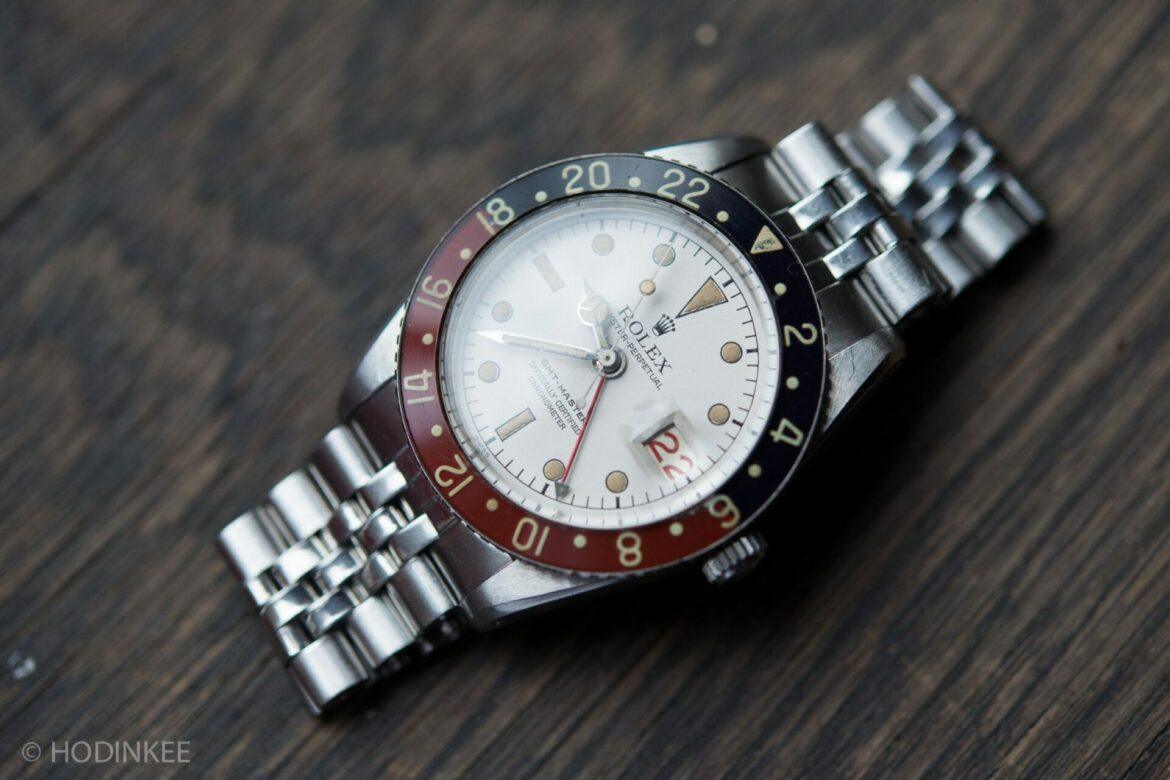
- The bezel in blue and red Bakelite
Case
The case is a three-piece oyster-type steel case and waterproof up to a depth of 50 meters (165 ft). The crown guards are absent, which we will find instead in later versions of the model.
The case back is the classic one produced by Rolex in those years with the inscription “Montres Rolex S.A.” in an arc and with the quarter of the year of production engraved at the bottom.

Dial
Production took off starting from 1954-55, initially mounting dials that we could define as prototypes, that is with red writing. Among them, the rarest by far are those with both the Gmt Master writing and the depth in red (three known examples).
The luminescent material composing the hands and filling the spheres was made of radium and strontium 90, substances dangerous due to their radioactivity. For this reason, in the following years many original dials were replaced by service dials with tritium.
At the bottom, under the inscription “Gmt Master,” the official chronometer certification held by the movement was affixed.
The ball game, as in the Submariner, was of the Mercedes type.
The date display was of the roulette type, meaning it alternated black numbers with red numbers, as in the photograph. However, towards the end of production, it is believed that it was replaced with the classic date display with only black numbers.

Movement
The base on which the movement of the 6542 was conceived was that of a 1030, which normally equipped the Turnograph model.
The caliber with which the 6542 was equipped was the 1036, renamed 1065 and finally 1066. It was equipped with a chronometer certificate and had a type of rotor that would later be renamed “butterfly” due to its shape.
The caliber with which the 6542 was equipped was the 1036, renamed 1065 and finally 1066. It was equipped with a chronometer certificate and had a type of rotor that would later be renamed “butterfly” due to its shape.

Bezel
The bakelite bezel of the Rolex GMT Master ref. 6542 is the element that makes this model, on one hand easily recognizable, but on the other incredibly difficult to find in its original condition, given its extreme fragility.
Bakelite is a plastic (or rather a resin) that, thanks to its appearance and vivid colors, gives the watch immense charm.

Radioactivity
In order to improve visibility in dark conditions, it was decided to fill the bezel numbers with a compound of radium and strontium 90. However, this choice caused quite a few headaches for Rolex. In fact, in the second half of the 1950s, studies on radioactivity revealed that these two materials (especially strontium) were extremely radioactive and dangerous, both for those who wore the watch, but especially for those who assembled the parts in the factory.

The other versions
Rolex Gmt Master 6542 yellow gold
So far we have talked about the 6542 in its most classic form. However, there is also a gold version, equally fascinating and perhaps even rarer.
The two versions share many elements in common, such as case and movement.
The main differences are:
- Bezel still in bakelite but single-color “burgundy”.
- Dial also in burgundy color.
- Hands no longer of the Mercedes type but "leaf-shaped".
- Gold logo applied on the dial.
Rolex Gmt Master 6542 “Albino”
The existence of a 6542 with a white dial is still a lively topic of debate among collectors.
The story goes that the then head of PAN-AM had noticed that some executives owned the GMT, which however was exclusively intended for pilots and crew members. So he wisely commissioned Rolex to create a very limited number of watches with a white dial, to be given, precisely, to the company’s top executives.

The 6542 on the big screen
Collectors as well as James Bond fans have nicknamed this reference “Pussy Galore”, as it was worn by the eponymous Bond Girl in the film “Goldfinger”, from 1964.